OEM vs Aftermarket Sewing Machine Parts: Buyer's Guide
Choosing between OEM and aftermarket sewing machine parts affects stitch quality, downtime, and cost per thousand garments. This guide gives you the actual numbers — hardness values, tolerance ranges, a step-by-step supplier qualification procedure, and a troubleshooting decision flow — so you can act on the trade-offs rather than just understand them. It covers presser feet, feed dogs, needle plates, bobbins, and hooks for lockstitch, overlock, and coverstitch machines.
Related guide: industrial presser foot — types, fitting and machine compatibility.
What "OEM" and "Aftermarket" Actually Mean
The terms are used loosely in the trade, so it helps to be precise.
- OEM parts are made by or for the machine builder — Juki, Brother, Jack, Pegasus, Kansai, Durkopp Adler — and sold under that brand, to the builder's original drawing and heat-treatment specification.
- Aftermarket parts are produced by independent manufacturers, either reverse-engineered from samples or built to public dimensional standards. Quality ranges from excellent to unusable, and the brand on the box tells you little.
- OEM-equivalent parts come from factories that already supply the machine builders but also sell the identical item under their own label. Same tooling, lower price. For most factory buyers this is the most interesting category.
Where OEM Parts Genuinely Earn Their Price
Some components sit in the middle of the stitch-forming process, where a few hundredths of a millimetre decides whether the machine runs or jams.
Hooks and rotary hook assemblies
The hook meets the needle several thousand times per minute. Three numbers matter: hook point hardness (typically 58–62 HRC on a good hook), raceway surface finish (Ra 0.2–0.4 µm), and radial runout (under 0.02 mm). A hook outside these ranges will run acceptably for a week and then start shedding timing. For high-speed lockstitch and overlock machines, OEM or verified OEM-equivalent hooks are usually the right call.
Needle plates and feed dogs
These work as a pair. The needle plate slot must be centred on the feed dog tooth pattern, and the two must be matched in width — a mismatch of more than 0.1 mm produces puckering on stretch fabric that no tension adjustment will fix. Feed dog tooth height is typically 0.6–0.9 mm depending on application; a variation of 0.15 mm across the tooth row is enough to cause uneven feed. OEM parts guarantee the pairing. Aftermarket parts require you to verify it.
Precision bobbins
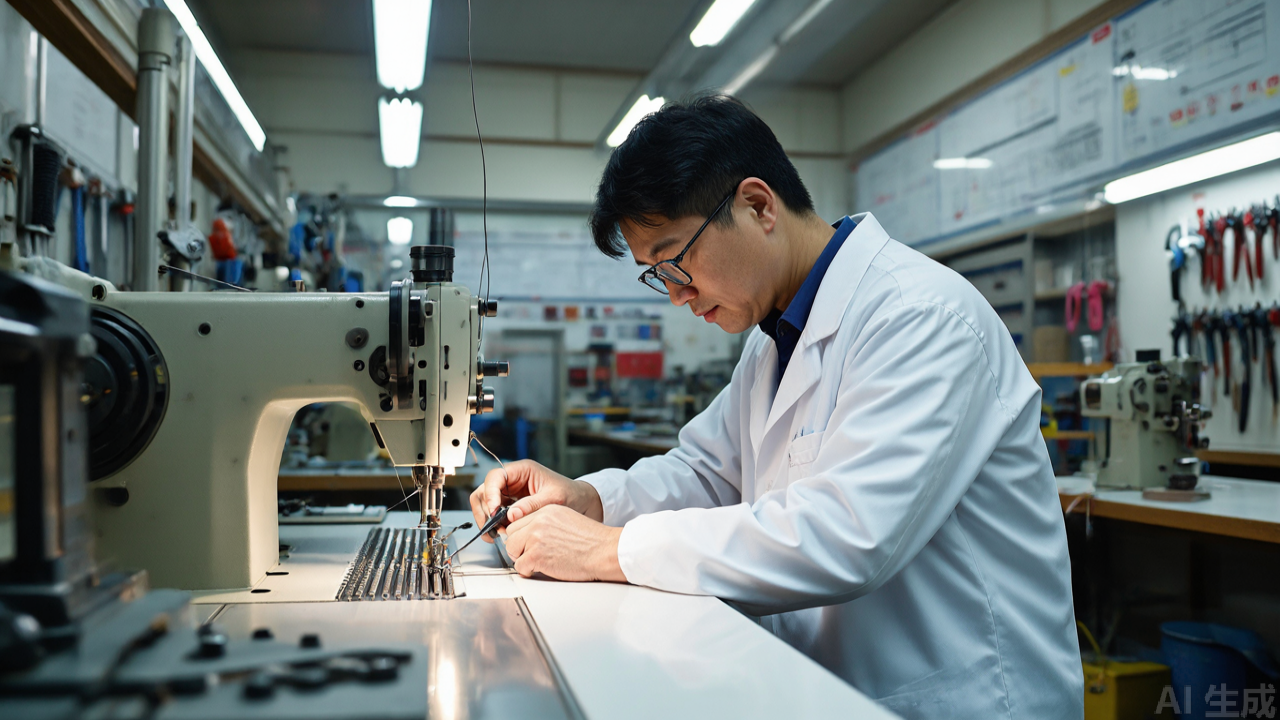
A bobbin more than 0.1 mm out of round causes tension flutter that shows as irregular stitches. Standard M-size bobbins are nominally 20.5 mm flange diameter, 11.5 mm barrel, 8.5 mm width; a good supplier holds ±0.05 mm on flange diameter and ±0.02 mm on barrel concentricity. The cost difference between a good bobbin and a bad one is a few cents per unit — cheap bobbins are a false economy once you count re-threading time and rejected seams.
Where Aftermarket Parts Are the Sensible Choice
Plenty of components have no meaningful effect on stitch quality. Paying OEM prices for these is simply a transfer of margin to the machine builder.
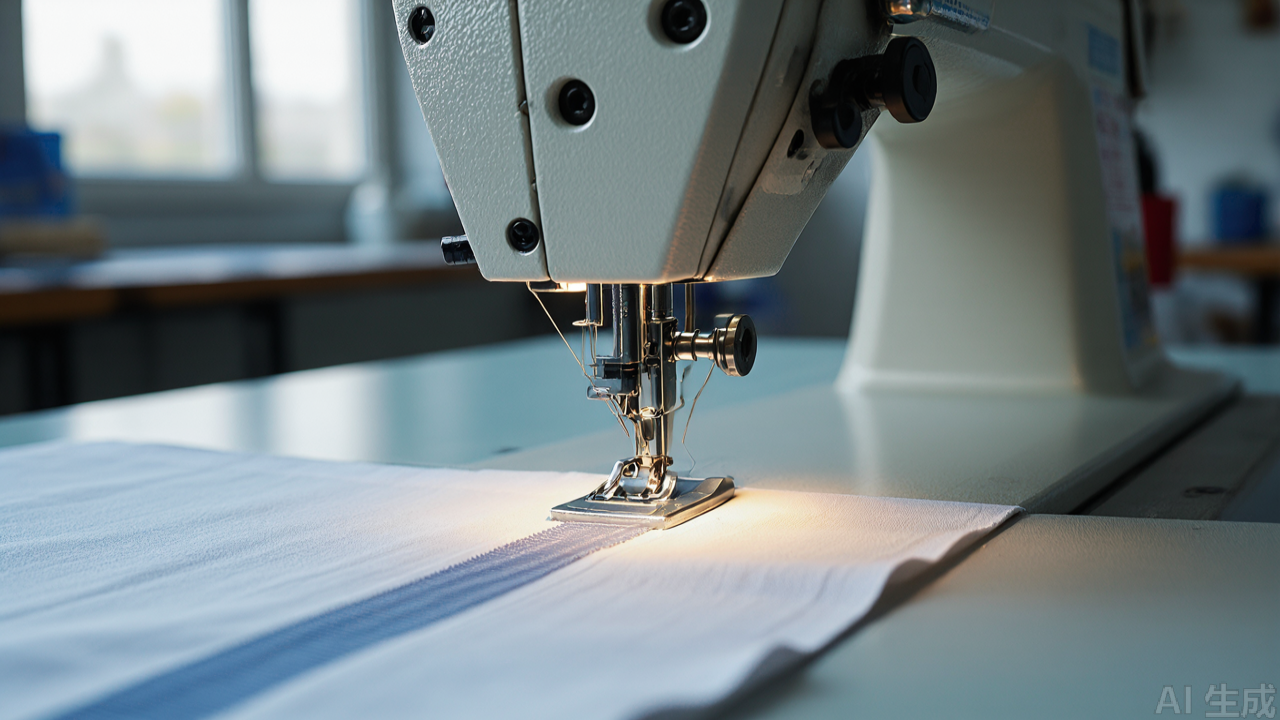
- Standard presser feet. A plain industrial presser foot is formed, hardened steel with a defined shank. If the shank dimensions, sole flatness (within 0.05 mm across the sole), and bottom finish are correct, it performs identically to the OEM item. This is where a well-made aftermarket industrial presser foot makes clear financial sense, especially on machines running multiple product styles where feet are changed frequently.
- Bobbins for low-speed operations. On slower machines or where seam appearance is not critical, dimensional tolerance matters less.
- Consumable guides, folders, and attachments. These wear out or become obsolete long before the machine does.
- Obsolete machine support. When a builder discontinues a model, aftermarket is often the only source left. The alternative is scrapping a machine that still runs.
Cost Comparison: Price Per Unit vs Cost Per 1,000 Units
Factory buyers tend to compare purchase price. The more useful number is cost per thousand garments, which includes three things the invoice does not show.
- Downtime. A failed hook stops a line. At 4,000 stitches per minute and roughly 3,000 stitches per garment, thirty minutes of unplanned stoppage on one machine is about 40 garments lost — often more than the price difference on a full set of parts.
- Rework and seconds. Skipped stitches, puckering, and uneven feed produce garments that need inspection, repair, or downgrading. This cost usually dwarfs the parts budget.
- Operator friction. Parts that need constant adjustment slow the operator and increase fatigue-related errors.
The practical rule most factories settle on: OEM or OEM-equivalent for anything in the stitch-forming path, aftermarket for everything else — provided you qualify the supplier first.
A Step-by-Step Supplier Qualification Procedure
Most aftermarket quality problems are not inherent to aftermarket manufacturing. They come from buying on price alone. Run every new supplier through these five steps before placing a production order.
Step 1 — Request documentation (Week 1)
- Dimensional drawing with tolerances for the specific part number. A supplier who cannot provide one is not controlling tolerances.
- Material grade and heat-treatment specification: steel grade, hardening method, and target hardness in HRC.
- Surface finish specification (Ra value) for any part that contacts thread or fabric.
Step 2 — Order and inspect a sample batch (Weeks 2–3)
- Order 10–20 pieces of a single part number, not a mixed sample set. Mixed samples hide batch variation.
- Measure five pieces with calipers and a micrometer. Record the spread, not just the average. A supplier whose parts vary by 0.05 mm is different from one whose parts vary by 0.2 mm, even if both averages are on spec.
- Check hardness on at least two pieces with a portable tester if the part is load-bearing.
Step 3 — Production trial (Weeks 3–4)
- Install the sample parts on the actual machine models in your factory, at production speed, for a full shift.
- Log stitch quality every hour: skipped stitches, thread breaks, seam puckering, tension drift.
- Bench testing at low speed tells you very little. Run at the speed the line actually uses.
Step 4 — Batch consistency check (Month 4)
- Order the same part number again three months later and measure both batches against each other.
- Consistency, not peak quality, is what keeps a line running. A supplier who drifts between batches will cost you more than one who is slightly off-spec but stable.
Step 5 — Traceability audit (Ongoing)
- Ask which production batch a delivered part came from. A supplier who can answer can also investigate a problem. One who cannot, cannot.
- Set a re-qualification interval — annually for general consumables, every six months for anything near the stitch-forming path.
Troubleshooting Decision Flow: Is It the Part or the Setup?
When a machine misbehaves, the part is not always the culprit. Work through this sequence before replacing anything.
Symptom: skipped stitches appearing after hours of running, not immediately
- Check needle condition and needle bar height first. A bent needle or a needle set 0.3 mm too high mimics a hook fault.
- If the needle is correct, check hook timing. If timing drifts within a shift, the hook point has lost hardness. Replace with OEM or OEM-equivalent.
- If timing holds but stitches still skip at high speed, check hook radial runout with a dial indicator. Over 0.03 mm means replacement.
Symptom: puckered seams on light fabric
- Reduce presser foot pressure first. On light fabric, excessive pressure alone causes puckering.
- If pressure adjustment does not help, check the needle plate and feed dog as a pair. A slot-width mismatch over 0.1 mm is the usual cause.
- If the pair is matched, inspect the presser foot sole for curvature. A sole that is not flat within 0.05 mm will lift the fabric unevenly.
Symptom: inconsistent bobbin tension
- Swap in a known-good bobbin before touching the tension assembly. Out-of-round bobbins are the most common cause.
- If a good bobbin fixes it, measure your stock bobbins for roundness. Anything over 0.1 mm out of round should be rejected.
- If the problem persists with a good bobbin, then inspect the bobbin case for wear or thread grooves.
Symptom: premature wear on the presser foot sole
- Check whether the wear pattern is even. An uneven pattern means the foot is not flat, not just soft.
- If the wear is even but fast, the surface hardening is insufficient. Ask the supplier for the target hardness and verify with a portable tester.
- If the wear is on one side only, the foot shank or the machine's presser bar may be misaligned.
Building a Sourcing Strategy That Holds Up
The most durable approach is a two-tier parts policy, documented and reviewed on a fixed schedule.
Tier one — critical path. Hooks, needle plates, feed dogs, and precision bobbins. Source from OEM or from a supplier who can demonstrate OEM-equivalent tooling and material. Keep at least one qualified second source, because single-sourcing a critical part is a production risk regardless of who makes it. Re-qualify every six months.
Tier two — general consumables. Standard presser feet, guides, folders, and low-tolerance items. Source from qualified aftermarket manufacturers, hold buffer stock equal to one full changeover cycle plus one shift, and re-qualify annually.
For buyers sourcing from China, the practical difficulty is rarely finding suppliers — it is separating the ones who control tolerances from the ones who only control price. Requesting drawings, material specs, and batch samples filters the field quickly.
For reference, PL's full parts catalog — including presser feet, feed dogs, needle plates, bobbins, and hooks — is documented with dimensional specifications at pinseam.com, which is useful if you need a starting point for comparing part numbers across machine models.
Frequently Asked Questions
Are aftermarket parts always lower quality than OEM?
No. Some aftermarket manufacturers use the same tooling and material grades as the original. The variation is in the supplier, not the category. Qualification is what separates them.
Will using aftermarket parts void a machine warranty?
This depends on the machine builder and your region. In many cases, warranty terms require OEM parts for covered repairs. Check the terms before switching on machines still under warranty.
How many spare presser feet should a factory hold?
Enough to cover one full changeover cycle plus a buffer. For factories running multiple styles, that typically means one spare per active foot profile per shift, with a shared pool for low-use profiles.
Can OEM and aftermarket parts be mixed on the same machine?
Yes, and most factories do. The risk is in paired components — needle plate and feed dog, hook and bobbin case. Keep those pairs from the same source, whether OEM or aftermarket.
PL (Professional Leader) supplies sewing machine parts for industrial lockstitch, overlock and interlock machines, including the industrial presser foot range, needle plates, feed dogs and related presser foot accessories. The full sewing machine parts and presser foot catalogue is listed at pinseam.com.
Need this part for your workshop?
Get a Free Quote on WhatsApp: +86 137 3825 6697Browse the full catalog at pinseam.com · Free 2026 full catalog (PDF) · Related guide: industrial presser foot
📢 New arrivals & factory updates on Telegram — join our channel
Edited by the technical team at PL (Professional Leader) — high-quality sewing machine accessories from China. About our factory | Catalog: pinseam.com | WhatsApp: +86 137 3825 6697 | Telegram: @plsewingparts
Explore Our Parts Guides
- sewing machine accessories, needle threaders & thread guides
- industrial & magnetic seam guides
- presser foot guide: types & compatibility
- industrial presser feet for factory lines
- roller & rolled hemmer presser feet
- industrial sewing machine parts & spare parts
- wholesale sewing machine parts, factory direct
- about PL (Professional Leader)
Questions about a specific part? Chat with us on WhatsApp +86 137 3825 6697 — factory direct, reply within hours.


Comments
Post a Comment